Structure
Chunk the source into headings, concepts and places students can return to.
 SynlectoConnect More resources
Jisc Connect More 2026 resource hub
From recorded access to source-grounded study routes
A practical, tool-agnostic method for turning recordings and transcripts into study routes that structure the source, activate students, show limits and support review.
Resources are open and designed for use alongside institutional policy, academic review, accessibility practice and local data rules.
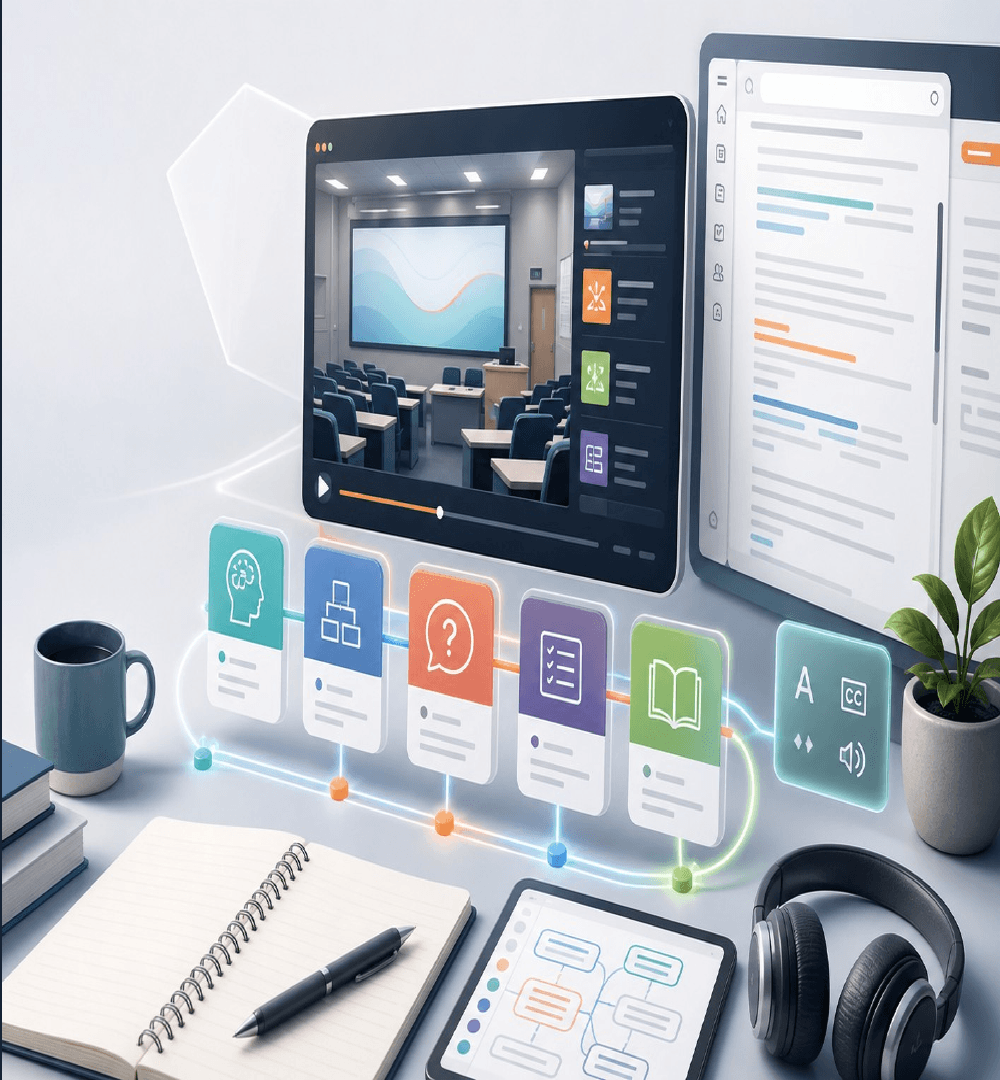
Lecture recordings give students a second chance with teaching, but a long video or raw transcript is not automatically a study route. The session focuses on helping students return to the source with structure, active recall, accessible signposting and visible boundaries.
Chunk the source into headings, concepts and places students can return to.
Use recall, reflection and short tasks so students still do the learning work.
Make clear what AI can support and what it cannot claim, especially where review is needed.
Show source basis, caveats, quality checks and review routes before student use.
The issue has shifted. Many institutions already have recordings, transcripts, captions, VLE spaces and emerging AI guidance. The question is how those pieces help students learn without turning generated support into a shortcut around the lecture.
A source-grounded route gives students a starting path, not a final account. It shows what source was used, what to practise, what to check, and where academic review or course context is still needed.
The design question
What should students do with the recording once it exists?The next maturity step is not more tools. It is clearer study design, boundaries and support around materials students already use.
UCISA 2024
UCISA reported that 89% of responding higher education institutions had lecture capture used by students.
Jisc 2024/25
Jisc reported that 34% of higher education students had used AI tools for learning, while 23% had institutional AI access.
Jisc 2024/25
Jisc reported that 37% of students lacked access to a suitable device at some point, which reinforces the need for inclusive design.
Nordmann and McGeorge
The stronger design question is not simply whether recordings affect attendance. It is how recorded sources support targeted consolidation.
The deck sets out the sector context, reusable method, implementation routes, prompt pattern, review checklist, university-readiness questions and pilot model.
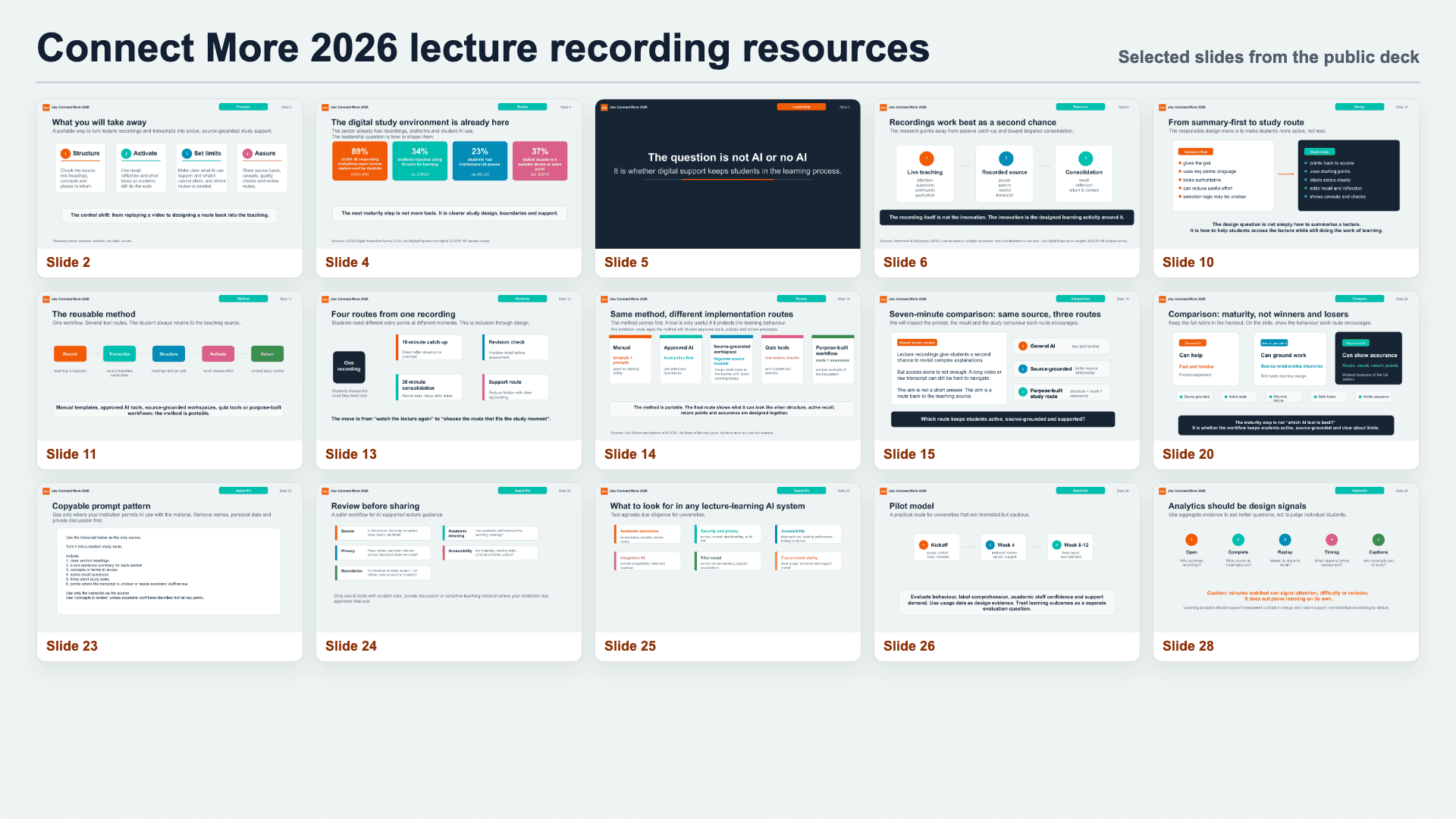
Practical files from the session, including the public handout, prompt bank and slide deck. Resources are available without sign-up.
PDF - 221 KB
A concise handout for the session framing, reusable method and practical review questions.
PDF - 189 KB
Copyable prompt patterns, safer language and review checks for transcript work.
PDF - 526 KB
The Connect More 2026 slide deck on source-grounded study routes.
An accurate summary can still weaken learning if it makes students feel they have finished before they have retrieved, explained or applied anything.
The design question is not simply how to summarise a lecture. It is how to help students access the lecture while still doing the work of learning.
One workflow, several implementation routes. The student always returns to the teaching source.
The lecture captures the teaching and keeps the source available.
The transcript gives staff and students a searchable source layer.
Headings, concepts and signposts reduce the load of long-form content.
Recall questions and short tasks move students beyond passive replay.
Clear return points keep the lecture, slides and course context central.
Record. Transcribe. Structure. Activate. Return.
Lecture recordings sit across place, platform, pace, blend, flexibility and support. They often become part of asynchronous study, where students need clearer routes through learning materials.
Live time can be protected for application, clarification, belonging and academic interaction.
Recordings often sit inside Canvas, Moodle, Blackboard, Panopto, Echo360 or another institutional system.
Students return to recordings at different speeds and at different points in the term.
A route can connect the lecture, transcript, slides, quiz tools and support materials.
Recordings can support catch-up, consolidation, revision and accessibility needs.
Students still need guidance on how to use recorded material well.
Students need different entry points at different moments. This is inclusion through design.
Orient after absence or overload with a small number of concepts and places to return.
Revisit the main ideas after class through summaries, recall and source checks.
Practise recall before assessment while caveats and lecturer guidance stay visible.
Reduce friction with clearer signposting, accessible structure and explicit return points.
The method comes first. A tool is useful only if it protects the learning behaviour.
Use headings, prompts and a simple review checklist.
Good for starting safely.Use institutional policy first and keep human review routes clear.
Prompts and boundaries matter.Organise source material and make caveats visible.
Still needs learning design.Turn transcript sections into low-stakes checks and recall practice.
Useful for confidence and retrieval.Design source, route, recall, return points and assurance together.
The full pattern in one workflow.Worked example
The worked example shows what the full pattern can look like when structure, active recall, return points and visible assurance are designed together. The important criteria are source grounding, clear structure, useful student activity and honest limits.
The lecture transcript remains the starting point.
Students see sections, concepts to review, prompts and practice tasks.
Students are asked to retrieve, explain and check understanding.
The route points students back to the lecture instead of replacing it.
Limits, review status and student purpose are visible.
This is study support unless reviewed by academic staff. It is not official lecture notes, proof of learning outcomes or a replacement for the lecture.
Trust is not created by a polished output. Trust is created by showing source, limits, review status and student purpose.
What source was used?
What has been generated?
What has not been checked?
Has academic meaning been reviewed?
Does the student know what to do next?
Is there a route back to the lecture?
Are privacy and institutional AI rules respected?
Use these only where your institution permits AI use with the material. Remove names, personal data and private discussion before using any AI tool.
Use the transcript below as the only source.

Turn it into a student study route.

Include:
1. clear section headings
2. a one-sentence summary for each section
3. concepts or terms to review
4. active recall questions
5. three short study tasks
6. points where the transcript is unclear or needs academic staff review

Rules:
- Do not add subject knowledge that is not present in the transcript.
- Do not call anything "key points" unless reviewed by academic staff.
- Do not say the guide is complete.
- Include reminders to return to the lecture, slides or course materials where context matters.Create four study routes from this lecture transcript:
1. a 10-minute catch-up route
2. a 30-minute consolidation route
3. a revision check route
4. a support route for students who need clearer signposting
Each route should tell the student:
- what to read
- what to answer
- what to check
- what to return to in the lecture
Keep every route grounded in the transcript. Show where the transcript is unclear or incomplete.Use this lecture transcript to create active recall tasks.
Create:
1. five short-answer recall questions
2. three "explain this to another student" prompts
3. two application questions
4. one short revision check
5. reminders to return to the lecture where context matters
Keep all questions and suggested answers grounded in the transcript.
Do not treat practice completion as proof of learning.Review this AI-supported study route before it is shared with students.
Check:
1. Is the lecture, transcript or caption track clearly identified?
2. Is the academic meaning accurate where it can be checked?
3. Are any summaries misleading or too complete-sounding?
4. Are names, personal data or private discussion included?
5. Are headings, reading order, contrast and links usable?
6. Is it labelled as study support, not official notes?
7. Does it point students back to the lecture source?
Suggest changes before release.A safer workflow for transcript-based study routes before they become student-facing.
Is the lecture, transcript or caption track clearly identified?
Has a lecturer or subject specialist checked meaning where needed?
Have names, personal data and private discussion been removed?
Are headings, reading order, contrast and links usable?
Is it labelled as study support, not official notes or proof of mastery?
Does it avoid exam-loaded claims unless reviewed?
Can students return to the relevant lecture or transcript section?
A tool-agnostic due diligence checklist for academic assurance, accessibility, privacy and controlled pilot review.
Review routes, source basis and academic meaning.
Assess consent, data handling and who can read what.
Review headings, reading order, contrast and cognitive load.
Check current compatibility, limits and setup.
Start small, review outcomes and support demand.
Separate clear evidence from roadmap promises.
Check whether students understand labels, caveats and return points.
Use aggregate evidence to improve design, not to judge individuals by default.
Viewing data can help staff ask better design questions, but it should not be treated as proof of learning on its own.
Minutes watched can signal attention, difficulty or revision. It does not prove learning on its own.
Who opens the recording or route?
What counts as meaningful use?
Where do students return?
What happens before assessment or after difficult topics?
Are transcripts part of study?
Designing for students who need structure often improves the learning route for students who did not know they needed structure.
Better value from existing recording, VLE and AI investments; clearer responsible-AI adoption.
Academic judgement stays central; student support is labelled, bounded and active.
More manageable routes through long recordings, with recall, reflection and flexibility.
Scalable structure and navigation support without replacing reasonable adjustments.
The resources on this page are open. Use the relevant form below for questions about the session, lecture recording practice, accessibility or university readiness.
For questions about the resource hub, lecture recording practice, accessibility or the reusable method.
Send a session questionFor institutional teams exploring whether a bounded review of source-grounded study routes is ready to be scoped.
Start a readiness conversationReferences used for the session framing around digital learning, lecture capture, accessibility, retrieval practice and AI-supported study.